
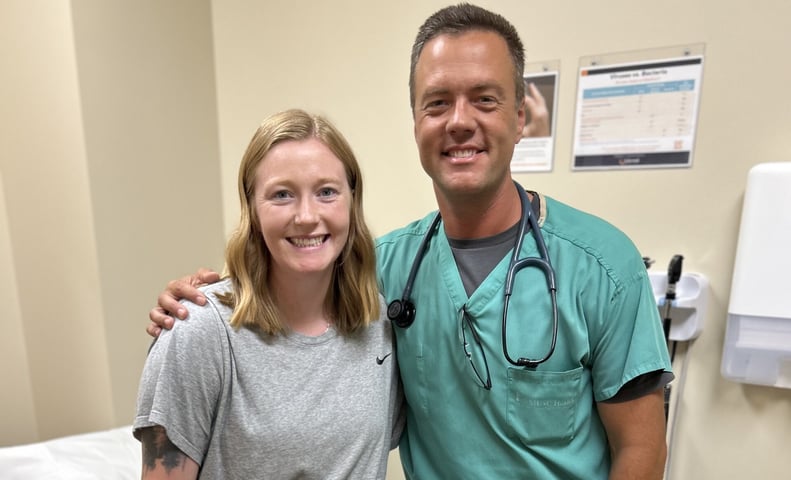
When MacKenzie May decided to become a surrogate, her motivation was simple. She wanted to give someone else the opportunity to experience the joy of parenthood.
MacKenzie, who was born and raised in Staples and now lives near Motley, first considered surrogacy while pregnant with the younger of her two daughters, Karter, 3½, and Maddyn, 2. Her sister was preparing to start a family, and MacKenzie told her that if she was unable to carry a child, MacKenzie would do it for her.
Her sister went on to have a healthy baby, but the idea stayed with MacKenzie.
“I love my own children so much,” she said. “And my heart hurts for people who want to become parents and aren’t able to. I wanted to help someone else experience that.”
Not quite a year later, MacKenzie began working with a surrogacy agency. She created a profile and was eventually introduced virtually to a prospective mother from Singapore.
MacKenzie had planned to be selective about the person she chose to help, but their connection was immediate.
“I met her and thought, ‘Nope, she’s the one,’” MacKenzie recalled. “She was so down-to-earth and personable. I felt really good about it.”
Throughout the pregnancy, the two stayed in close contact. MacKenzie shared updates following appointments, sent ultrasound images and messaged whenever she felt the baby move.
“When I felt him kick, the excitement wasn’t for myself, it was excitement for her,” MacKenzie said. “I would message her and say, ‘I finally felt him,’ or tell her about a big movement. I wanted to share everything I could so she could feel like she was part of the pregnancy.”
Their conversations also gave both women an opportunity to learn about one another’s lives and cultures. They exchanged family photos, discussed their different experiences, and talked about the joys and uncertainties of motherhood.
As the baby’s arrival approached, the intended mother traveled to Minnesota. She joined MacKenzie for an ultrasound and an appointment with Lakewood’s Dr. Ryan Kroll before the scheduled cesarean delivery. The time together allowed them to become better acquainted.
Following the delivery of a healthy 8-pound, 13-ounce baby boy, the intended mother was able to be in surgery and meet her son immediately. MacKenzie’s husband remained beside MacKenzie to support her, while the Lakewood team helped the new mother welcome and care for her baby.
“I saw her standing there, just glowing. She was smiling from ear to ear, and I told her, ‘Congratulations, I’m so happy for you.’ It was really cool to see,” MacKenzie recalled.
Providing a positive experience
Dr. Kroll said caring for a surrogate pregnancy involves supporting both the person carrying the baby and the intended parent while making sure everyone understands the plan and feels included.
“The medical care itself doesn’t change, but the situation requires additional communication,” Dr. Kroll said. “You’re caring for the patient carrying the baby while also discussing the intended parent’s wishes and helping create a meaningful experience for everyone.”
MacKenzie said that thoughtful communication was evident throughout her pregnancy and delivery. She felt strongly about receiving her care at Lakewood because of the positive experience she had while delivering her second daughter there.
“At one point, the agency wanted me to deliver in St. Cloud, but my contract stated that I wanted to be at Lakewood,” she said. “As long as the baby was healthy and Lakewood could safely provide the care we needed, this was where I wanted to be.”
MacKenzie appreciated how the Lakewood team listened to her previous birth experiences, addressed her concerns, and advocated for the intended mother to be part of the delivery.
“They do the little things that really matter,” she said. “You always feel cared for. They went above and beyond what I expected.”
Valuable learning opportunity
The experience was also a valuable learning opportunity for medical students training at Lakewood. Medical students spend an extended period in a rural community, where they participate in a broad range of care and follow patients through experiences that may span the clinic, hospital and delivery room.
A surrogate pregnancy allows students to see that obstetric care is not only about the medical needs of a pregnancy. It may also involve navigating unique family structures, cultural considerations, privacy, legal agreements and the wishes of several people, all while keeping the health and autonomy of the patient at the center of care.
“You might not anticipate encountering an international surrogacy experience at a smaller rural hospital,” Dr. Kroll said. “But being in a rural setting doesn’t mean students have limited experiences. They may care for patients and families from many different places and encounter situations they might expect to see only at a large hospital.”
That broad exposure helps future physicians learn to approach each patient and family with compassion and respect.
MacKenzie said the most rewarding lesson came in one unforgettable moment: seeing a new mother’s face as she met her son.
“She gave me the opportunity to do something incredible for someone else,” MacKenzie said. “Seeing her glow and smile from ear to ear when she saw her baby boy — that was the best part.”
Later, in a heartfelt message to MacKenzie, the intended mother expressed what her selfless gift meant to her: “Thank you, from the bottom of my heart, for giving me the chance to become a mom.”
Photo above: MacKenzie (Holst) May is pictured with Dr. Ryan Kroll, who cared for her throughout her extraordinary surrogacy journey and delivered the healthy baby boy carried for an intended mother from Singapore.